fotoflōt pro panel 30in wide by 20in tall
Glazing surface: 1/16in matte/non-glare
Float distance from wall: 3/4in
Wall mount hardware: Z-bar cleat
Price includes all wall mount hardware.
Cash or purchase through our online store.
UPS Ground shipment available to domestic addresses for a small extra charge.
This panel shows an image of the rolling sand dunes in the expansive Rub' al Khali desert on the southern Arabian Peninsula are taken by the Sentinel-2A satellite.
Also known at the 'Empty Quarter', the Rub' al Khali is the largest contiguous sand desert in the world. Precipitation rarely exceeds 35 mm a year and regular high temperatures are around 50°C.
The yellow lines and dots in this false-colour image are sand dunes. Looking closer at the dunes in the lower right, many have three or more 'arms' shaped by changing wind directions and are known as 'star dunes'. They tend to 'grow' upwards rather than laterally, and reach up to 250 m in height in some parts of the Rub' al Khali.
The dunes are interspersed with hardened flat plains - remnants of shallow lakes that existed thousands of years ago, formed by monsoon-like rains and runoff. The multispectral instrument on Sentinel-2 uses parts of the infrared spectrum to detect subtle changes in vegetation cover, but can also see changes in mineral composition where vegetation is sparse. In this image, shades of brown to bright purple show the mineral composition, possibly including salt or gypsum.
This image - also featured on the Earth from Space video programme - was captured by Sentinel-2A on 22 December 2015. The satellite is the first in the two-satellite Sentinel-2 mission for Europe's Copernicus programme, and carries a wide-swath high-resolution multispectral imager with 13 spectral bands for a new perspective of our land and vegetation.
We are a very high quality custom printing service and create stunning viewing experiences from our customers’ digital photography and art by printing them on our magnetic float-mounted fotoflōt classic or large format fotoflōt pro panels.
As such we generally do not sell panels with images that we select, but we have a few pieces with curated stunning Space and Earth satellite images.
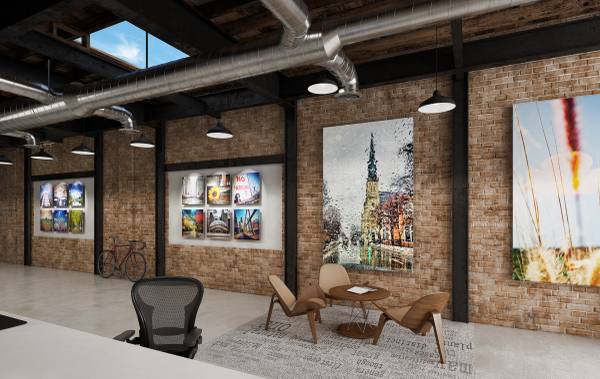
The fotoflōt pro construction technique has been used in Europe for decades and becomes more popular in photo galleries, museums, and commercial and private decor in the US. It is often referred to as "C-print mounted to plexiglass" and the most iconic large-format photographs have been constructed this way, such as 99 Cent II Diptychon, Chicago Board of Trade, or Shanghai by German photographer Andreas Gursky.
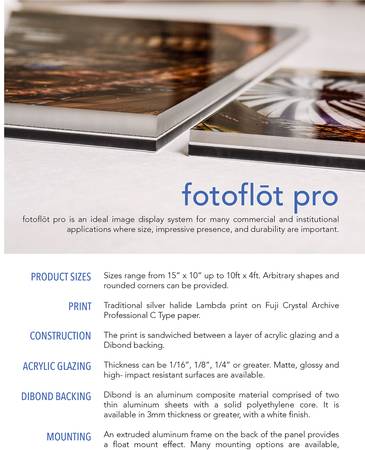
fotoflōt pro panels start as traditional silver-halide photo prints that are permanently "sandwiched" between a layer of clear acrylic glazing in the front and a sheet of stabilizer in the back. Panels need no frame or mat so that the image goes all the way to the (invisible) edge.
This fotoflōt pro panel comes with a "float mount box" attached to the back for a dramatic wall mounted floating display and has been constructed as follows:
* An extremely high resolution image has been printed on the glossy version of Fuji Crystal Archive Professional C Type photo paper. The silver-halide continuous tone photo print was made on a 50in wide Durst Lambda printer.
* Fuji Crystal Archive Professional C type paper is one of the most resilient and fade-resistant photo papers available. It has been tested by Wilhelm Imaging Research, the industry’s “gold standard” for testing of photo paper durability. Their tests show that it can be exposed to normal interior lighting and indirect sunlight for decades without perceptible fading from either light or air pollution. The panels shouldn't be displayed where they will receive direct sunlight for extended periods of time, as no display method can prevent fading under those conditions.
* The print was permanently "sandwiched" between a layer of clear acrylic glazing and a sheet of white 3mm Dibond as a stabilizer in the back.
* We have selected the compound aluminum Dibond backing for its superior dimensional stability across a wide temperature range.